

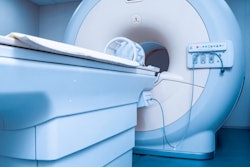
The switching of gradient coil fields in MRI scans of patients with metallic hip implants can have thermal effects that imaging professionals need to look out for, according to a presentation at this week's International Society for Magnetic Resonance in Medicine (ISMRM) virtual conference.
"Whereas direct heating of tissues induced by the exposure to radiofrequency fields is largely analyzed in the literature, less attention is devoted to the thermal effects due to the switching of gradient coil (GC) fields," Alessandro Arduino, PhD, postdoctoral researcher at the National Institute of Research into Metrology (INRiM) in Turin, and colleagues noted in a digital poster. "Experimental and computational results show the possible heating of bulky metallic orthopedic implants due to eddy currents."
For the echo-planar imaging (EPI) sequence, the heating process is mainly driven by the frequency-encoding signal, and the exchange of the roles of slice selection and phase encoding does not affect the maximum temperature elevation, they pointed out. The heating is strongly dependent on the position of the body within the scanner: The researchers found almost no heating when the implant is at z ≈ 0 from the scanner center, whereas the worst cases occur with z ≈ 300 mm.
EPI is needed to perform functional MRI and diffusion-tensor imaging, but it is particularly susceptible to significant artifacts, such as signal reduction and image distortion from implants.
The pulse sequences are divided into subsignals, and each subsignal is expanded in Fourier series and the electromagnetic field solutions are computed in frequency domain by a hybrid finite element/boundary element method. The solutions are moved in time domain to reconstruct the instantaneous evolution of the joule power density, known as Pem. This reduces the computational burden by around 90% for the EPI, the authors wrote.
They modeled the temperature increase through the Pennes bioheat transfer equation driven by Pem and accounting for thermoregulation. The calculation is made on a graphics processing unit using a finite difference method and Douglas-Gunn time split.
The Turin group's results refer to the GC fields produced according to an EPI sequence by a tubular MRI scanner, where the concomitant component Bx reaches the same values as Bz. The patient was represented by the Duke model of the virtual population, in which a cobalt-chromium-molybdenum-alloy (CoCrMo) hip prosthesis had been inserted in the right leg. A 12-minute exposure was simulated.
| Imaging plane | Slice section | Phase encoding | Frequency encoding | Maximum Gz |
| Sagittal | Gx | Gy | Gz | 3.2 |
| Sagittal | Gx | Gz | Gy | 1.86 |
| Transverse | Gz | Gx | Gy | 1.86 |
| Transverse | Gz | Gy | Gx | 3.24 |
| Coronal | Gy | Gx | Gz | 3.2 |
| Coronal | Gy | Gz | Gx | 3.24 |
"The reliability of the method has been proven by reproducing the outcome of a heating experiment with an acetabular cup exposed to GC fields. The cup has been both embedded in a gel phantom or thermally insulated," stated Arduino, who completed his PhD in 2017 on MR-based electric properties tomography.
The ISMRM study formed part of project number 17IND01 (Procedures allowing medical implant manufacturers to demonstrate compliance with MRI safety regulations, or MIMAS), he added. It received funding from the European Metrology Programme for Innovation and Research (EMPIR) and was co-financed by the Participating States and from the European Union's Horizon 2020 Research and Innovation Program.
For further information about this topic, the authors recommend the following article: A. Arduino, et al. In silico evaluation of the thermal stress induced by MRI switched gradient fields in patients with metallic hip implant. Physics in Medicine & Biology, 2019;64(24):245006.
.fFmgij6Hin.png?auto=compress%2Cformat&fit=crop&h=100&q=70&w=100)



.fFmgij6Hin.png?auto=compress%2Cformat&fit=crop&h=167&q=70&w=250)


