

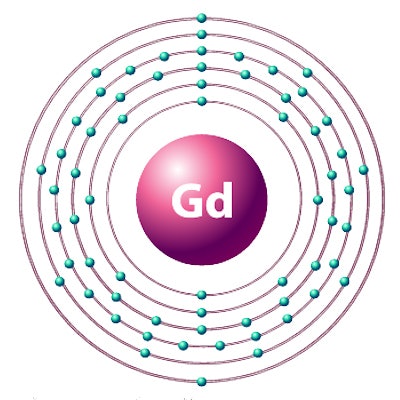
Using gadolinium-based contrast agents (GBCAs) for cardiac MRI carries a risk of less than 1% for allergic reactions -- although macrocyclic GBCAs do appear to be safer than linear ones, according to a study published October 29 in Radiology: Cardiothoracic Imaging.
The results address concerns regarding gadolinium-based contrast agents (GBCAs), some of which have been shown to remain in the body long after scans are completed and may be toxic, wrote a team led by Dr. Johannes Uhlig of the University Medical Center in Goettingen, Germany.
"In this study, the overall acute adverse events incidence in GBCA-enhanced cardiac MRI was 0.38%, which is in line with earlier [study] results," the group wrote.
Cardiac MRI is an effective way to image the heart, and the majority of these exams use gadolinium contrast to boost visualization of the heart muscle and blood flow. Contrast MRI is also used to evaluate scars on the heart tissue and to identify cardiac ischemia or diseases like cardiomyopathy and myocarditis. GBCAs are either linear or macrocyclic; linear agents are considered to have higher likelihood of being retained in the body compared to macrocyclic products, the team noted.
Due to gadolinium retention concerns, protocols for using linear GBCAs vary around the world. As a protective measure, in 2017 the European Medicines Agency (EMA) rescinded marketing authorization of linear GBCAs, except for liver imaging; although the U.S. has not issued regulatory restrictions, the U.S. Food and Drug Administration (FDA) recommends that physicians consider gadolinium retention factors when choosing GBCAs, according to Uhlig and colleagues.
For the study, the group took data from the European Society of Cardiovascular Radiology MRCT Registry to assess the effect of the EMA's decision, tracking the use of linear GBCAs as well as adverse events attributed to any GBCAs. The study included 154,779 cardiac MRI scans, 95% of which used GBCAs.
The researchers found that use of linear GBCAs for cardiac MRI fell from 15.2% in 2011 to less than 1% in 2018 and 2019. They also found that the rate of adverse events for contrast-enhanced MRI was low, at 0.38% (556 events); of these, only 47 were severe.
"GBCA administration changed according to recent regulatory decisions, with almost exclusive use of macrocyclic agents for cardiac MRI in 2018 and 2019," the group wrote.
It's important for physicians to evaluate their patients for any contraindications to cardiac MRI with GBCAs, but overall, it appears that the risk of adverse events caused by gadolinium contrast is low, according to the team.
"Using a large-scale patient cohort from several European countries, our study demonstrates that the administration of GBCA for cardiac MRI is safe for the overwhelming majority of patients," Uhlig said in a statement released by the RSNA. "In particular, macrocyclic GBCAs exhibit a favorable acute safety profile, and should be considered for cardiac MRI examinations evaluating myocardial scarring, ischemia, cardiomyopathy, and myocarditis."
![Overview of the study design. (A) The fully automated deep learning framework was developed to estimate body composition (BC) (defined as subcutaneous adipose tissue [SAT] in liters; visceral adipose tissue [VAT] in liters; skeletal muscle [SM] in liters; SM fat fraction [SMFF] as a percentage; and intramuscular adipose tissue [IMAT] in deciliters) from MRI. The fully automated framework comprised one model (model 1) to quantify different BC measures (SAT, VAT, SM, SMFF, and IMAT) as three-dimensional (3D) measures from whole-body MRI scans. The second model (model 2) was trained to identify standardized anatomic landmarks along the craniocaudal body axis (z coordinate field), which allowed for subdividing the whole-body measures into different subregions typically examined on clinical routine MRI scans (chest, abdomen, and pelvis). (B) BC was quantified from whole-body MRI in over 66,000 individuals from two large population-based cohort studies, the UK Biobank (UKB) (36,317 individuals) and the German National Cohort (NAKO) (30,291 individuals). Bar graphs show age distribution by sex and cohort. BMI = body mass index. (C) After the performance assessment of the fully automated framework, the change in BC measures, distributions, and profiles across age decades were investigated. Age-, sex-, and height-adjusted body composition reference curves were calculated and made publicly available in a web-based z-score calculator (https://circ-ml.github.io).](https://img.auntminnie.com/mindful/smg/workspaces/default/uploads/2026/05/body-comp.XgAjTfPj1W.jpg?auto=format%2Ccompress&fit=crop&h=100&q=70&w=100)




![Overview of the study design. (A) The fully automated deep learning framework was developed to estimate body composition (BC) (defined as subcutaneous adipose tissue [SAT] in liters; visceral adipose tissue [VAT] in liters; skeletal muscle [SM] in liters; SM fat fraction [SMFF] as a percentage; and intramuscular adipose tissue [IMAT] in deciliters) from MRI. The fully automated framework comprised one model (model 1) to quantify different BC measures (SAT, VAT, SM, SMFF, and IMAT) as three-dimensional (3D) measures from whole-body MRI scans. The second model (model 2) was trained to identify standardized anatomic landmarks along the craniocaudal body axis (z coordinate field), which allowed for subdividing the whole-body measures into different subregions typically examined on clinical routine MRI scans (chest, abdomen, and pelvis). (B) BC was quantified from whole-body MRI in over 66,000 individuals from two large population-based cohort studies, the UK Biobank (UKB) (36,317 individuals) and the German National Cohort (NAKO) (30,291 individuals). Bar graphs show age distribution by sex and cohort. BMI = body mass index. (C) After the performance assessment of the fully automated framework, the change in BC measures, distributions, and profiles across age decades were investigated. Age-, sex-, and height-adjusted body composition reference curves were calculated and made publicly available in a web-based z-score calculator (https://circ-ml.github.io).](https://img.auntminnie.com/mindful/smg/workspaces/default/uploads/2026/05/body-comp.XgAjTfPj1W.jpg?auto=format%2Ccompress&dpr=2&fit=crop&h=167&q=70&w=250)


