A 10-year clinical trial shows that hypofractionated radiotherapy, which delivers radiation in fewer sessions over 3 weeks instead of 5 weeks, is safe and effective for high-risk breast cancer patients after mastectomy, with comparable survival rates and disease control to conventional treatment.
- Treatment comparison: Hypofractionated radiotherapy (43.5 Gy in 15 fractions over 3 weeks) versus conventional radiotherapy (50 Gy in 25 fractions over 5 weeks)
- 10-year locoregional recurrence rates: 12.0% with hypofractionation versus 10.3% with conventional treatment, meeting non-inferiority standards
- Survival outcomes: No significant differences in 10-year disease-free survival (69.9% vs 65.2%) or overall survival (77.5% vs 72.9%)
- Safety profile: No grade 4-5 late toxicities or brachial plexopathy reported; minimal asymptomatic pulmonary fibrosis occurred slightly more with hypofractionation
- Clinical impact: Three long-term trials worldwide now support hypofractionated radiotherapy as standard care for high-risk breast cancer patients
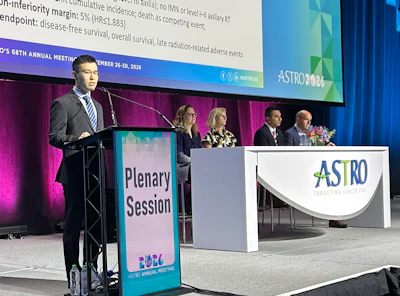
Hypofractionated radiotherapy is a safe and efficient alternative to conventional fractionation in women with high breast cancer after mastectomy, according to a study presented September 28 at the American Society for Radiation Oncology (ASTRO) annual meeting.
Guang-Yi Sun, MD, of the Chinese Academy of Medical Sciences in Beijing, China, discussed 10-year outcomes from a phase III trial comparing the two techniques, with results suggesting that adopting hypofractionated radiotherapy could improve patient convenience and healthcare efficiency without compromising long-term disease control.
“Hypofractionated postmastectomy radiotherapy provides durable locoregional control, comparable survival outcomes, and acceptable long-term toxicity in high-risk breast cancer,” Sun said.
Radiotherapy after mastectomy is standard of care for high-risk breast cancer patients to reduce the risk of recurrence. Hypofractionated radiotherapy delivers larger daily doses of radiation over a shorter total number of sessions, whereas conventional fractionation delivers smaller daily doses over a longer period of weeks.
While hypofractionated radiotherapy is well established for whole-breast irradiation after breast-conserving surgery, there is little long-term data on its use post-mastectomy, Sun added.
To bridge the gap, Sun and colleagues enrolled 820 women with high-risk breast cancer (≥ 4 positive axillary nodes or T3–T4 disease) who had undergone modified radical mastectomy and axillary dissection at a national cancer center in China between 2008 and 2016. Participants were randomized 1:1 to either conventional radiotherapy (50 Gy in 25 fractions over 5 weeks) or hypofractionated radiotherapy (43.5 Gy in 15 fractions over 3 weeks) to the chest wall and supraclavicular region.
The primary endpoint was five-year locoregional recurrence (LRR), with a pre-specified non-inferiority margin of five percentage points. Median follow-up was 11.5 years.
At five years, LRR was 8.6% with conventional fractionation and 9.6% with hypofractionation, meeting the non-inferiority margin. At 10 years, rates remained stable at 10.3% and 12.0%, with curves showing no late separation. No significant differences were observed in 10-year disease-free survival (65.2% vs. 69.9%) or overall survival (72.9% vs. 77.5%).
In addition, no grade 4–5 late toxicities or brachial plexopathy were reported. Grade 1–2 pulmonary fibrosis occurred more frequently with hypofractionation (19.7% vs. 11.7%; p = 0.008), although all events were asymptomatic, Sun noted.
"These long-term results further establish hypofractionated postmastectomy radiotherapy with regional nodal irradiation as a standard of care for patients with high-risk breast cancer," Sun concluded.
Including the present study, there are now three long-term clinical trials worldwide that support a 3-week schedule of hypofractionated radiotherapy in this patient population, Sun concluded.