Radiologists' workloads have increased by almost a third due to the implementation of the 21st Century Cures Act, which mandated that imaging reports be made immediately available to patients, according to a letter published January 19 in the Journal of the American College of Radiology.
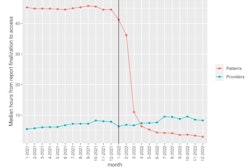
A team led by Steven Rowe, MD, PhD, of the University of Texas Southwestern Medical Center in Dallas cited a study conducted by letter co-author Jessica Porembka, MD, and colleagues that reported not only the workload increase after the Cures Act but also that patients were 39% more likely to contact radiologists "regarding either a clarification or a request for an addendum."
"In this era of ever-increasing volumes of complex studies, many radiologists are already experiencing burnout and job dissatisfaction," Rowe and colleagues wrote. "Further, we may only be seeing the tip of the iceberg in downstream effects from the 21st Century Cures Act, given that over time more and more patients will be 'digital natives.'"
How can radiology departments and practices ease the added workflow? The authors offered three tips:
- Radiologists must "very carefully choose their words in the impressions of reports to not feed into potential confusion and anxiety for patients," they wrote, noting that "it is common to see radiology impressions that end with some variation of the phrase "cannot be excluded," even when the interpreting radiologist knows that what they are "not excluding" is highly unlikely," and that "open-ended statements that properly convey a sense of uncertainty, without directly naming remote possibilities, may be preferable."
- Departments and practices should invest in "generative artificial intelligence (AI) tools that allow for the translation of radiologists' reports into lay language for consumption by patients," they urged, explaining that "as more patients use AI to receive their health information, radiologists can improve patient-centered care by providing both accurate and patient-friendly reports."
- Departments and practices "can use non-radiologists such as radiology assistants, nurses, and advanced practice providers to interact with patients who have questions or requests that cannot be adequately handled by generative AI tools," Rowe and colleagues wrote, noting that potential tasks might include "answering calls and Epic/MyChart messages, making preliminary addenda to address any objectively incorrect statements in a report, and communicating with the radiologist about patients' concerns that require physician specialty/subspecialty expertise."
The bottom line? The effects of the 21st Century Cures Act will continue to manifest going forward, and radiologists need to be proactive to address them, according to the team.
"The time is now for departments and practices to take measures to mitigate the added workload, stress, and job dissatisfaction that immediate patient access to imaging reports is creating," it concluded.
Access the full letter here.