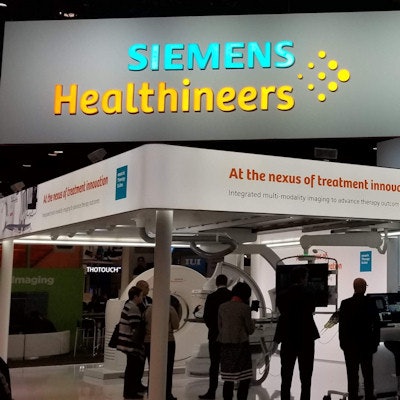
Siemens Healthineers has received clearance from the U.S. Food and Drug Administration (FDA) for its Mobilett Elara Max mobile x-ray system.
Features of the Mobilett Elara Max include enhanced IT security to block cyber threats and secure system integration into a hospital's IT environment for easy access to patient data.
The company's virtual workstation technology provides access to patient information directly at the bedside. The ergonomic design includes an antimicrobial coating and fully integrated cables that create an unobstructed front view, allowing for improved maneuverability. In addition, 180° lateral arm movement expands positioning options.




![Representative example of a 16-year-old male patient with underlying X-linked adrenoleukodystrophy. (A, B) Paired anteroposterior (AP) chest radiograph and dual-energy x-ray absorptiometry (DXA) report shows lumbar spine (L1 through L4) areal bone mineral density (BMD). The DXA report was reformatted for anonymization and improved readability. The patient had low BMD (Z score ≤ −2.0). (C) Model (chest radiography [CXR]–BMD) output shows the predicted raw BMD and Z score in comparison with the DXA reference standard, together with interpretability analyses using Shapley additive explanations (SHAP) and gradient-weighted class activation maps. The patient was classified as having low BMD, consistent with the reference standard. AM = age-matched, DEXA = dual-energy x-ray absorptiometry, RM2 = room 2, SNUH = Seoul National University Hospital, YA = young adult.](https://img.auntminnie.com/mindful/smg/workspaces/default/uploads/2026/04/ai-children-bone-density.0snnf2EJjr.jpg?auto=format%2Ccompress&dpr=2&fit=crop&h=167&q=70&w=250)


