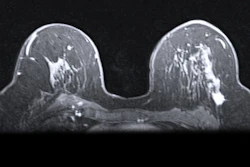
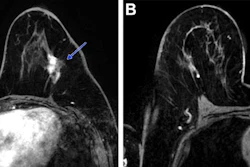
The Kaiser score, a diagnostic tool that evaluates multiple MRI features including spiculations, enhancement curves, margins, and edema, outperforms traditional MRI BI-RADS assessment for identifying malignant breast lesions in patients with inconclusive or suspicious findings, achieving 97% sensitivity and 98% diagnostic accuracy.
- Kaiser score achieved 97% sensitivity and 0.98 area under the curve compared to MRI BI-RADS 60.6% sensitivity and 0.88 AUC
- The scoring system ranges from 1 (minimum risk) to 11 (maximum risk) and incorporates spiculations, enhancement curves, margins, internal patterns, and edema
- Study included 99 women (66 benign, 33 malignant cases) who underwent breast MRI for BI-RADS 0 or 4 findings between 2022-2024
- Kaiser score cutoff of >5 showed superior performance in predicting malignancy compared to MRI BI-RADS cutoff of >4
- Results suggest Kaiser score could reduce unnecessary biopsies and healthcare costs while improving diagnostic accuracy for inconclusive breast lesions
Kaiser scoring could support lesion stratification when used with MRI BI-RADS assessment, suggest findings published October 18 in the European Journal of Radiology.
For breast lesions classified as BI-RADS 0 or 4 on mammography, the Kaiser score showed excellent diagnostic accuracy on breast MRI, wrote researchers led by Ece Zengin, MD, from Tokat Gaziosmanpaşa University in Türkiye.
“Our findings indicate that the Kaiser score is a highly effective tool for differentiating benign from malignant breast lesions in patients with BI-RADS 0 or 4 findings on conventional imaging,” Zengin and colleagues wrote.
BI-RADS 0 or 4 lesions may lead to unnecessary biopsies and more costs for patients and healthcare systems. The Kaiser score ranges between 1 (minimum risk) and 11 (maximum risk). It incorporates spiculations, breast MRI enhancement curves, margins, internal enhancement patterns, and edema into risk scoring.
The Zengin team focused its study on the Kaiser score to predict malignancy in women who underwent breast MRI following inconclusive or suspicious imaging findings (BI-RADS 0 or 4), based on pathology results or clinical follow-up.
The study included 99 women who underwent breast MRI between 2022 and 2024 due to inconclusive mammography and ultrasound results or suspicious findings. The women also had either histopathological evaluation following biopsy under ultrasound or mammography guidance or were followed for at least 12 months. The team divided the women into a benign (n = 66) and malignant cohort (n = 33).
The team observed significant differences between both groups for the following patient-level factors: age (p < 0.001), age at menarche (p = 0.004), breastfeeding status (p = 0.009), menopausal status (p = 0.017), and use of hormone replacement therapy (p = 0.036). It also noted higher MRI BI-RADS and Kaiser scores (p < 0.001 for both) in the malignant group.
Kaiser scoring showed strong diagnostic predictive value for malignancy when using a cutoff score of > 5, outperforming MRI BI-RADS with a cutoff value of > 4.
Comparison between Kaiser score, MRI-BI-RADS | |||
Measure | MRI BI-RADS | Kaiser score | P value |
Area under the curve | 0.88 | 0.98 | < 0.001 |
Sensitivity | 60.6% | 97.0% | N/A |
Specificity | 100% | 87.9% | N/A |
In multivariable logistic regression, higher Kaiser score (odds ratio [OR] = 4.25, p < 0.001) and older age (OR = 1.16, p = 0.041) showed associations with higher odds of malignancy. But older age at menarche showed ties to lower odds (OR = 0.35, p = 0.03).
The study authors suggested the Kaiser score’s higher performance in the study could be due to this approach’s integration of several morphologic and kinetic MRI features into a stepwise decision model.
However, they added that the Kaiser score’s potential effect on biopsy decisions should be interpreted cautiously.
“Biopsy decisions should remain based on integrated clinical and imaging findings,” the authors wrote.
Read the full study here.