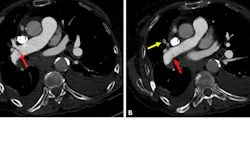
PITTSBURGH – AI triaging with CT pulmonary angiography (CTPA) does not lead to better efficiency in pulmonary embolism (PE) care, suggest findings presented April 14 at ARRS 2026.
AI did not lead to improvements in turnaround time or length of stay for PE patients, according to a presentation given by Michelle Li from Yale University in New Haven, CT.
“As the use of AI in medicine increases and we begin to assess the value of these AI tools, I think it’s important to reflect whether we deploy AI more broadly or perhaps we identify more personalized care delivery settings where AI may be more useful,” Li said.
 Michelle Li shares results from her team's study on how AI triaging affects report turnaround times and patient outcomes at ARRS 2026.
Mortality rates for untreated PE are around 30% and dyspnea remains in about 50% of patients following PE, according to prior research. Early diagnosis and treatment can improve patient outcomes.
Li and colleagues studied whether AI triaging can help with early diagnosis. In this workflow, CTPA images are automatically reviewed by a machine learning algorithm. If the algorithm detects a PE, it alerts radiologists in real time via a pop-up message in their work list.
The study compared results from before AI implementation (2017 to 2019) and after AI implementation (2020 to 2022). The Li team focused its study on report turnaround times, time to treatment, and patient outcomes.
The retrospective cohort study included 484 patients who were admitted into the emergency department with either intermediate–high- or high-risk PE. The researchers used an internally developed (nonvalidated) pulmonary health score to measure outcomes. A score of one represented no residual symptoms, while a score of five indicated severe dyspnea at rest and/or patients being always on supplemental oxygen supply.
Li reported no significant differences report turnaround times between both time periods, with overall turnaround times between just over one hour for each period (p = 0.81). She also reported no significant differences in time to anticoagulation (p = 0.07) and time to alteplase/thrombectomy (p = 0.08).
AI also did not lead to improvements in patient length of stay (p = 0.4). While the pre-AI cohort’s average length of stay was about 5.9 days, the AI cohort’s average was about 6.1 days. Pulmonary health scores also did not significantly differ between the two cohorts (p = 0.16). However, Li noted no mortalities in either cohort.
The team also performed a subanalysis on report turnaround times. It found that report turnaround times are significantly faster during the day (p < 0.001). While day-shift workers experienced turnaround times of about half an hour on average, night-shift workers experienced slower turnaround times of about two hours. Despite this finding, pulmonary health scores did not significantly differ between the respective staffing groups (p = 0.89).
“This suggests to me that the limiting factor in improving patient outcomes is likely not how quickly the radiology report is generated,” Li said.
Despite the results, Li said AI could be more helpful in situations with higher report turnaround times at baseline, such as lower-resource hospitals or outpatient settings.
“I think that in settings with lower staffing or potentially in pathologies that you don’t usually require STAT imaging for, the use of AI could help in improving diagnosis and being able to bring positive cases toward the top of a radiologist’s worklist,” Li told AuntMinnie.
She added that future plans include expanding the study’s sample size and examining the perspective of outpatient clinics.