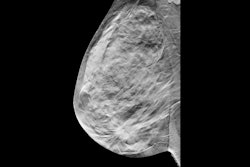
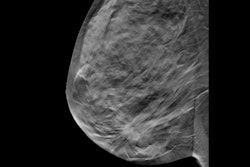
Dense breast tissue lowers the performance of digital breast tomosynthesis (DBT), according to a study published January 13 in Academic Radiology.
Investigators led by Ariel Kniss, MD, PhD, of Massachusetts General Hospital in Boston found that extremely dense breast tissue significantly lowers DBT’s sensitivity. DBT also achieves lower specificity in extremely dense breasts than in those consisting of almost entirely fatty tissue.
“These findings highlight the need to report and consider breast density in screening recommendations and necessitate further research on more effective screening regimens for women with dense breast tissue,” Kniss and colleagues wrote.
Breast density in recent years has become a critical factor in developing best practices for screening strategies for personalized screening protocols. Breast density status is organized into four categories: almost entirely fatty (category A), scattered areas of fibroglandular density (category B), heterogeneous dense tissue (category C), and extremely dense tissue (category D).
The U.S. Food and Drug Administration (FDA) in 2024 enacted a mandate that requires imaging facilities to notify patients about their breast density status. Kniss and co-authors pointed out that large-scale studies that directly quantify how breast density affects screening outcomes remain limited. Prior research suggests that DBT is superior to digital mammography for imaging dense breasts.
The researchers evaluated the impact of breast density on the performance metrics of screening DBT exams, reviewing 301,400 exams collected between 2013 and 2019 from 111,143 women with an average age of 59. The DBT exams were performed at a single academic medical center, and the team calculated performance metrics according to the fifth edition of the BI-RADS Atlas.
The team reported the following representation for breast density categories: category A, 8.8%; category B, 50.5%; category C, 36.9%; and category D, 3.8%.
DBT achieved the highest cancer detection rate with category B breast density. It also gradually dropped in sensitivity from categories A through D, with the highest drop being from category C to D. DBT maintained high specificity among all categories, with the lowest being for category C.
DBT’s performance among breast density categories | ||||
Measure | Category A | Category B | Category C | Category D |
Cancer detection rate (per 1,000 exams) | 3.4 | 5.6 | 5.2 | 3.7 |
Sensitivity | 92.8% | 90.1% | 81% | 61.8% |
Specificity | 96.7% | 94.4% | 92.5% | 93.3% |
The group also reported that category D was tied to significantly lower sensitivity than each of the other categories (adjusted odds ratios [aOR], 0.19; p < 0.01 for all). Category D was associated with significantly lower specificity than almost entirely fatty tissue (aOR, 0.64; p < 0.001) but not the other two density categories.
The findings support the FDA mandate on breast density notification and highlight the importance of incorporating breast density into screening protocols, the study authors wrote.
“The quantitative data from our analysis can help inform future screening recommendations and shape policy decisions,” they added.
Read the full study here.