AI-measured myosteatosis from coronary artery calcium (CAC) CT scans appears to be an important harbinger of future chronic obstructive pulmonary disease (COPD), researchers have reported.
This finding was shown to be independent of known risk factors for COPD, wrote a team led by Amir Azimi, MD, of HeartLung.AI in Houston, TX. Azimi and colleagues' study was published January 29 in Radiology: Cardiothoracic Imaging.
"AI-quantified myosteatosis from baseline CAC CT scans strongly predicted incident clinically diagnosed COPD," the group noted. "After adjusting for [covariates such as] age, sex, body mass index, race, smoking history, asthma, physical activity, inflammatory markers, and insulin resistance, participants with myosteatosis (lowest quartile of thoracic skeletal muscle mean attenuation) demonstrated a 2.74-fold increased risk of developing COPD compared with those in the highest quartile."
COPD is a preventable lung condition, but it remains a leading cause of morbidity and mortality around the world, the group explained. Although researchers have identified environmental and genetic risk factors for the disease, there are gaps in understanding of COPD pathogenesis, "highlighting the critical need for novel predictive biomarkers to enable early detection and targeted prevention, particularly in traditionally low-risk populations," the authors wrote.
Azimi et al evaluated the predictive value of myosteatosis as an opportunistic finding in CAC CT scans for clinically diagnosed COPD, comparing imaging results to an AI-measured emphysema biomarker identified on the same scans. They conducted a study that included baseline CAC CT scans and 20-year follow-up data from 5,535 participants in the Multi-Ethnic Study of Atherosclerosis (MESA). The investigators defined myosteatosis as the lowest quartile of thoracic skeletal muscle mean attenuation (< 33.5 HU in men and < 27 HU in women) and quantified the emphysema-like lung biomarker as the percentage of lung voxels below -950 HU in CAC CT scans. They identified COPD cases using diagnostic codes from hospital discharge records.
Among the total participant cohort, 7.1% were diagnosed with COPD over the 20-year follow-up period. The group found that myosteatosis showed a stronger association with COPD than emphysema (unadjusted hazard ratios [HRs], 5.98 and 2.12, respectively; p < 0.001). These HRs were reduced, however, after the researchers adjusted for covariates, with an HR for myosteatosis of 2.74 and for emphysema of 1.5 (p = 0.02).
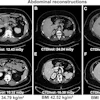
 Example images of noncontrast, electrocardiographically gated coronary artery calcium CT (CAC CT) in the axial plane (section thickness, 2.5 mm). AI overlays show thoracic skeletal muscle (red) and intermuscular adipose tissue (yellow) for two MESA participants who never smoked, both with low emphysema-like lung percentage and evidence of myosteatosis, and who developed COPD during follow-up. (A) A 68-year-old female participant diagnosed with COPD 12 years after imaging. (B) A 69-year-old male participant diagnosed 5 years after imaging. AI = artificial intelligence, COPD = chronic obstructive pulmonary disease, MESA = Multi-Ethnic Study of Atherosclerosis, TSM = thoracic skeletal muscle.Images and caption courtesy of the RSNA.
"AI-quantified myosteatosis from CAC CT scans represents a powerful independent predictor of incident COPD that outperforms emphysema-like lung measurements," the authors concluded. "Future research should incorporate longitudinal muscle quality assessments to clarify temporal relationships with subclinical lung function decline, use full chest CT with spirometry while excluding patients with spirometry-diagnosed COPD at baseline, and explore mechanistic pathways linking myosteatosis to COPD development.
Click here to access the full study.