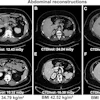
Brainomix is highlighting a study showing that quantitative CT measures derived from the company's e-Lung software are sensitive to the effects of antifibrotic treatment in patients with progressive pulmonary fibrosis.
The study, published in the American Journal of Respiratory and Critical Care Medicine, analyzed 474 patients from the high-resolution CT substudy of the Inbuild trial, comparing measurements from e-Lung with those from a University of California, Los Angeles research algorithm.
Treatment with nintedanib had significant effects on changes in e-Lung total disease extent at 24 and 52 weeks, as well as on reticulovascular and weighted reticulovascular scores at 24 weeks, the researchers found. Higher baseline scores on these measures were also associated with a greater rate of decline in forced vital capacity over 52 weeks.
The two quantitative CT methods showed broad consistency, providing cross-validation for their use in clinical trials of interstitial lung disease, Brainomix said.