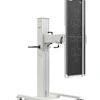
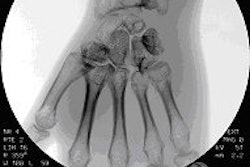
Toshiba America Medical Systems of Tustin, CA, will feature its Kalare radiography/fluoroscopy platform, the T.RAD Plus digital radiography system, and the Ultimax multipurpose x-ray system at the RSNA show.

Kalare is a new R/F platform with a color LCD touch panel, allowing tableside review and adjustment of critical parameters and additional dose reduction. New specifications for the 90/45° tilt table include the ability to accommodate larger patients up to 350 lb and six Grid Pulse fluoroscopy frame rates. Kalare is available in three different image intensifier sizes, and is equipped with a high-speed digital processor. It has FDA clearance, and is available for the U.S. market only.
The T.RAD Plus Digital is a flat-panel digital configuration of Toshiba's workhorse T.RAD Plus general-purpose radiography system. The system includes an 80-kW generator, floor- or ceiling-mount configurations, a tomography option, and lower kW generators.
The unit's integrated offset C-arm design enables the single detector to support both table and wall-mounted radiography applications, permitting users to do the work of two x-ray systems with a single panel. Clinical applications include bone and chest imaging. T.RAD Plus Digital has FDA clearance, and is available in the U.S. market only.
Toshiba's Ultimax multipurpose x-ray system is a 90/90° tilting table with 20° side-table rotation, 1-megapixel CCD imaging, and DVD archiving. The system can also be upgraded to a flat-panel digital configuration, and is available with Toshiba's EPS-Plus digital processor.
Ultimax provides remote and local operation, as well as rapid table and C-arm motion allowing virtually any position and projection when capturing high-resolution clinical images. Applications include diagnostic R/F, vascular intervention, nonvascular intervention, and bidirectional DSA bolus chase.
By Robert Bruce
AuntMinnie.com contributing writer
November 11, 2004
Copyright © 2004 AuntMinnie.com

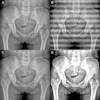
![Representative example of a 16-year-old male patient with underlying X-linked adrenoleukodystrophy. (A, B) Paired anteroposterior (AP) chest radiograph and dual-energy x-ray absorptiometry (DXA) report shows lumbar spine (L1 through L4) areal bone mineral density (BMD). The DXA report was reformatted for anonymization and improved readability. The patient had low BMD (Z score ≤ −2.0). (C) Model (chest radiography [CXR]–BMD) output shows the predicted raw BMD and Z score in comparison with the DXA reference standard, together with interpretability analyses using Shapley additive explanations (SHAP) and gradient-weighted class activation maps. The patient was classified as having low BMD, consistent with the reference standard. AM = age-matched, DEXA = dual-energy x-ray absorptiometry, RM2 = room 2, SNUH = Seoul National University Hospital, YA = young adult.](https://img.auntminnie.com/mindful/smg/workspaces/default/uploads/2026/04/ai-children-bone-density.0snnf2EJjr.jpg?auto=format%2Ccompress&fit=crop&h=100&q=70&w=100)


![Representative example of a 16-year-old male patient with underlying X-linked adrenoleukodystrophy. (A, B) Paired anteroposterior (AP) chest radiograph and dual-energy x-ray absorptiometry (DXA) report shows lumbar spine (L1 through L4) areal bone mineral density (BMD). The DXA report was reformatted for anonymization and improved readability. The patient had low BMD (Z score ≤ −2.0). (C) Model (chest radiography [CXR]–BMD) output shows the predicted raw BMD and Z score in comparison with the DXA reference standard, together with interpretability analyses using Shapley additive explanations (SHAP) and gradient-weighted class activation maps. The patient was classified as having low BMD, consistent with the reference standard. AM = age-matched, DEXA = dual-energy x-ray absorptiometry, RM2 = room 2, SNUH = Seoul National University Hospital, YA = young adult.](https://img.auntminnie.com/mindful/smg/workspaces/default/uploads/2026/04/ai-children-bone-density.0snnf2EJjr.jpg?auto=format%2Ccompress&fit=crop&h=112&q=70&w=112)