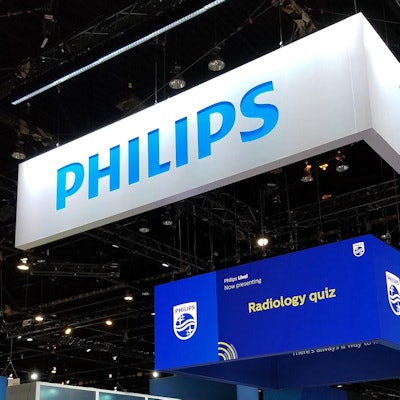
Philips announced new products and clinical data supporting the treatment of heart disease patients at the Transcatheter Cardiovascular Therapeutics (TCT) annual meeting.
Philips launched the following products and updates:
- IntraSight Mobile, which is now available in North America, is a mobile system for coronary and peripheral artery disease therapy that uses intravascular ultrasound (IVUS) imaging and physiologic measurements of fractional flow reserve (FFR) and instant wave-free ratio (iFR) to accurately identify the location of lesions causing ischemia.
- AngioSculpt Evo, a scoring balloon catheter that offers a smaller tip for smoother lesion entry, a hydrophilic coating to reduce friction, and a laser-cut hypotube for enhanced flexibility.
- Nexcimer, a laser system for coronary and peripheral atherectomy and lead extraction procedures. The system starts up within 30 seconds, uses standard medical-grade 100-to 240-volt outlets, and has a touchscreen interface with guided workflow.
Also, the company will report five-year outcomes of the iFR-SWEDEHEART trial at the meeting on November 4 at 1:45 p.m. Eastern time.
Finally, the results of a new large-scale analysis of U.S. Centers for Medicare and Medicaid Services (CMS) data on the clinical and economic outcomes of diagnosing and treating peripheral vascular disease using IVUS will be presented on November 6 at 2:24 p.m. Eastern time.


![Representative example of a 16-year-old male patient with underlying X-linked adrenoleukodystrophy. (A, B) Paired anteroposterior (AP) chest radiograph and dual-energy x-ray absorptiometry (DXA) report shows lumbar spine (L1 through L4) areal bone mineral density (BMD). The DXA report was reformatted for anonymization and improved readability. The patient had low BMD (Z score ≤ −2.0). (C) Model (chest radiography [CXR]–BMD) output shows the predicted raw BMD and Z score in comparison with the DXA reference standard, together with interpretability analyses using Shapley additive explanations (SHAP) and gradient-weighted class activation maps. The patient was classified as having low BMD, consistent with the reference standard. AM = age-matched, DEXA = dual-energy x-ray absorptiometry, RM2 = room 2, SNUH = Seoul National University Hospital, YA = young adult.](https://img.auntminnie.com/mindful/smg/workspaces/default/uploads/2026/04/ai-children-bone-density.0snnf2EJjr.jpg?auto=format%2Ccompress&fit=crop&h=100&q=70&w=100)




![Representative example of a 16-year-old male patient with underlying X-linked adrenoleukodystrophy. (A, B) Paired anteroposterior (AP) chest radiograph and dual-energy x-ray absorptiometry (DXA) report shows lumbar spine (L1 through L4) areal bone mineral density (BMD). The DXA report was reformatted for anonymization and improved readability. The patient had low BMD (Z score ≤ −2.0). (C) Model (chest radiography [CXR]–BMD) output shows the predicted raw BMD and Z score in comparison with the DXA reference standard, together with interpretability analyses using Shapley additive explanations (SHAP) and gradient-weighted class activation maps. The patient was classified as having low BMD, consistent with the reference standard. AM = age-matched, DEXA = dual-energy x-ray absorptiometry, RM2 = room 2, SNUH = Seoul National University Hospital, YA = young adult.](https://img.auntminnie.com/mindful/smg/workspaces/default/uploads/2026/04/ai-children-bone-density.0snnf2EJjr.jpg?auto=format%2Ccompress&dpr=2&fit=crop&h=167&q=70&w=250)


