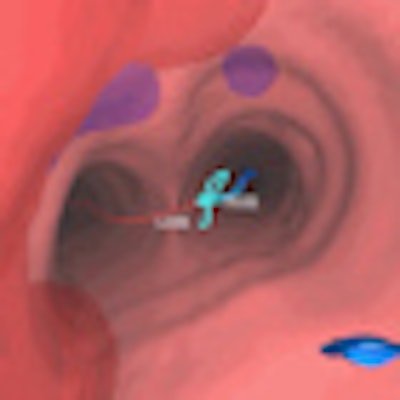
Software developer Broncus Medical highlighted a recent study published in the journal Respirology showing its Archimedes Virtual Bronchoscopic Navigation (VBN) System is safe and effective for guiding the sampling of peripheral pulmonary lesions.
The prospective single-arm multicenter study of 104 patients found the Archimedes VBN system resulted in a relatively high biopsy yield independent of the presence or absence of a bronchus sign (BS) and a high sampling yield and diagnostic yield independent of location, lesion size, and presence or absence of a BS (Respirology, February 25, 2022).
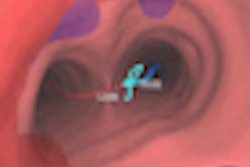
The Archimedes VBN System combines fused fluoroscopy, real-time bronchoscopy, and virtual bronchoscopic navigation for 3D views and access to nodules anywhere in the lung, with the ability to avoid major blood vessels through vessel mapping.
Specifically, the study showed that using Archimedes to guide bronchoscopic transparenchymal nodule access (BTPNA) enabled a sampling yield of 90.2% and a biopsy yield of 86.3%, while the sampling yield across both BTPNA and guided transbronchial needle aspiration was 93.9%.


![Representative example of a 16-year-old male patient with underlying X-linked adrenoleukodystrophy. (A, B) Paired anteroposterior (AP) chest radiograph and dual-energy x-ray absorptiometry (DXA) report shows lumbar spine (L1 through L4) areal bone mineral density (BMD). The DXA report was reformatted for anonymization and improved readability. The patient had low BMD (Z score ≤ −2.0). (C) Model (chest radiography [CXR]–BMD) output shows the predicted raw BMD and Z score in comparison with the DXA reference standard, together with interpretability analyses using Shapley additive explanations (SHAP) and gradient-weighted class activation maps. The patient was classified as having low BMD, consistent with the reference standard. AM = age-matched, DEXA = dual-energy x-ray absorptiometry, RM2 = room 2, SNUH = Seoul National University Hospital, YA = young adult.](https://img.auntminnie.com/mindful/smg/workspaces/default/uploads/2026/04/ai-children-bone-density.0snnf2EJjr.jpg?auto=format%2Ccompress&fit=crop&h=100&q=70&w=100)


![Representative example of a 16-year-old male patient with underlying X-linked adrenoleukodystrophy. (A, B) Paired anteroposterior (AP) chest radiograph and dual-energy x-ray absorptiometry (DXA) report shows lumbar spine (L1 through L4) areal bone mineral density (BMD). The DXA report was reformatted for anonymization and improved readability. The patient had low BMD (Z score ≤ −2.0). (C) Model (chest radiography [CXR]–BMD) output shows the predicted raw BMD and Z score in comparison with the DXA reference standard, together with interpretability analyses using Shapley additive explanations (SHAP) and gradient-weighted class activation maps. The patient was classified as having low BMD, consistent with the reference standard. AM = age-matched, DEXA = dual-energy x-ray absorptiometry, RM2 = room 2, SNUH = Seoul National University Hospital, YA = young adult.](https://img.auntminnie.com/mindful/smg/workspaces/default/uploads/2026/04/ai-children-bone-density.0snnf2EJjr.jpg?auto=format%2Ccompress&fit=crop&h=112&q=70&w=112)