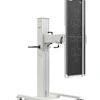
Canadian x-ray manufacturer KA Imaging and the charity Kenyan Kids Foundation Canada (KKFC) are collaborating to bring advanced medical imaging technology to Kenya.
This work aims to improve healthcare accessibility in remote regions of Kenya through the deployment of KA Imaging’s portable Reveal 35C technology. Reveal 35C is a single-exposure, portable, digital dual-energy subtraction x-ray detector that uses the same radiation dose as a chest x-ray to produce three different images without motion artifacts.
The project has two planned phases. The first involves installing Reveal 35C in a portable system at a rural hospital, while the second includes developing a mobile x-ray vehicle to extend imaging services to remote areas in the Cherangany Hills region in northern Kenya.
The project has an estimated cost of $100,000, which includes Reveal 35C, the x-ray source, software – including AI software for triage – and training. American x-ray accessories manufacturer RC Imaging will support the initiative by donating a carbon fiber protector with an antiscatter grid.

![Representative example of a 16-year-old male patient with underlying X-linked adrenoleukodystrophy. (A, B) Paired anteroposterior (AP) chest radiograph and dual-energy x-ray absorptiometry (DXA) report shows lumbar spine (L1 through L4) areal bone mineral density (BMD). The DXA report was reformatted for anonymization and improved readability. The patient had low BMD (Z score ≤ −2.0). (C) Model (chest radiography [CXR]–BMD) output shows the predicted raw BMD and Z score in comparison with the DXA reference standard, together with interpretability analyses using Shapley additive explanations (SHAP) and gradient-weighted class activation maps. The patient was classified as having low BMD, consistent with the reference standard. AM = age-matched, DEXA = dual-energy x-ray absorptiometry, RM2 = room 2, SNUH = Seoul National University Hospital, YA = young adult.](https://img.auntminnie.com/mindful/smg/workspaces/default/uploads/2026/04/ai-children-bone-density.0snnf2EJjr.jpg?auto=format%2Ccompress&fit=crop&h=100&q=70&w=100)


![Representative example of a 16-year-old male patient with underlying X-linked adrenoleukodystrophy. (A, B) Paired anteroposterior (AP) chest radiograph and dual-energy x-ray absorptiometry (DXA) report shows lumbar spine (L1 through L4) areal bone mineral density (BMD). The DXA report was reformatted for anonymization and improved readability. The patient had low BMD (Z score ≤ −2.0). (C) Model (chest radiography [CXR]–BMD) output shows the predicted raw BMD and Z score in comparison with the DXA reference standard, together with interpretability analyses using Shapley additive explanations (SHAP) and gradient-weighted class activation maps. The patient was classified as having low BMD, consistent with the reference standard. AM = age-matched, DEXA = dual-energy x-ray absorptiometry, RM2 = room 2, SNUH = Seoul National University Hospital, YA = young adult.](https://img.auntminnie.com/mindful/smg/workspaces/default/uploads/2026/04/ai-children-bone-density.0snnf2EJjr.jpg?auto=format%2Ccompress&fit=crop&h=112&q=70&w=112)