

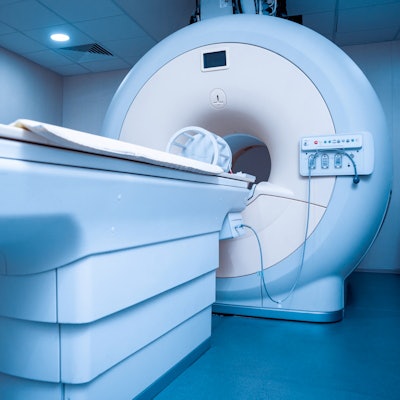
MRI safety is a serious issue, and it's critical that radiology departments and practices actively manage it for the welfare of both patients and personnel, according to a presentation delivered August 13 at the virtual AHRA annual meeting.
The American College of Radiology (ACR) released its first MRI safety guideline in 2007, and has updated it since then, said presenters William Faulkner and Kristan Harrington of MRI consulting firm William Faulkner & Associates. However, in April, the college released a new manual that offers more in-depth information on how best to safely perform MRI exams.
"Over the past 18 years, adverse incidents caused by MRI have increased significantly, including several deaths," Faulkner told session attendees. "MRI is a modality that can kill you instantly [if scanning is mismanaged]. It is very important for administrators and management to understand the risks and to create an environment for MRI that is safe for patients as well as all others who enter it."
New additions
The new manual now includes up-to-date information on new MRI applications and technology, such as intraoperative MRI and 7-tesla systems, Faulkner and Harrington said. It also outlines staffing guidelines -- namely that a minimum of two MRI technologists or one technologist and one other person with the "designation MR personnel" in zones II (reception area, dressing rooms, screening rooms), III (control room), and IV (where magnet is located) whenever patients are in the room; these staff must be within earshot of each other at all times.
Facilities must think through this staffing scheme for evening and emergency imaging, Faulkner said.
"Facilities must prepare for dealing with emergencies after normal business hours," he said. "Think about how you will staff your MRI suite."
The safety manual presents guidance on coping with emergencies that occur in the magnet room. Faulkner summarized the following:
- Don't attempt to treat medical emergencies in the scan room. Instead, remove the patient to a predetermined, MRI-safe area.
- Practice emergency protocols at least once a year, and more if possible. Run through all possible staffing scenarios.
- Make sure MRI staff understand that they control the MRI environment.
"One of our clients reported an incident that resulted in a delay in treatment," Faulkner said. "A floor nurse who was in attendance for a critically ill patient insisted that staff treat the patient in the scan room when the patient started to [fail] rather than allowing staff to remove the patient from the room [for stabilization]."
The new manual also outlines various formal leadership roles for the MRI suite, including the MR medical director (MRMD), the MR research director (MRRD), the MR safety officer (MRSO), and the MR safety expert (MRSE). Safety decisions are made by the medical director or the attending radiologist, Faulkner said; technologists implement established safety measures but don't determine them.
Eyelash check
Finally, Faulkner and Harrington reviewed the manual's guidance on identifying any ferromagnetic objects in either patients or staff before entering the magnet room. The new document includes an expanded patient questionnaire intended to discover whether a patient has any implants that need to be considered before scanning and a checklist MRI staff can use to ensure that the screening form has been completed, ferromagnetic detection has been performed -- watch for those magnetic eyelashes, Harrington said -- and any support devices have been checked, cleared, and labeled.
"Don't assume that either patients or staff are ferrous-free," Faulkner said.
It's vital for patient and staff safety that administrators and MRI staff be aware of MRI's risks and actively manage them, according to Faulkner and Harrington.
"Understanding how to effectively educate staff and implement culture changes in daily work habits helps to reduce and possibly eliminate these risks," they concluded.

.fFmgij6Hin.png?auto=compress%2Cformat&fit=crop&h=100&q=70&w=100)




.fFmgij6Hin.png?auto=compress%2Cformat&fit=crop&h=167&q=70&w=250)


