A new research center at the University of Pittsburgh in Pennsylvania aims to bring health lessons learned from spaceflight to patients on Earth, including from imaging data.
The University of Pittsburgh Health Sciences on January 29 launched the Trivedi Institute for Space and Global Biomedicine, which aims to develop new breakthrough therapeutics and medical technologies, with imaging having a role.
 Medical leaders at the University of Pittsburgh discuss the launch of the Trivedi Institute for Space and Global Biomedicine. From left to right: Anantha Shekhar, MD, PhD, senior vice chancellor for the health sciences and John and Gertrude Petersen Dean, School of Medicine; Kate Rubins, PhD, founding director of the institute; Christopher Mason, PhD, visiting adjunct professor of surgery at Pitt; and Ashok Trivedi, a Pittsburgh-based entrepreneur, investor, and philanthropist who donated $25 million to the institute, which is named after him.
“Our goal is to use spaceflight as a tool to study biology, to develop medical technologies, and to translate what we learn into better outcomes on Earth,” said Kate Rubins, PhD, who joined the university in October 2025 as a professor of computational and systems biology.
Before her arrival at Pitt, Rubins served as an astronaut for NASA, which included two long-duration missions for a total of 300 days in space. She was the first person to sequence DNA in space. She also led multiple studies in genomics and human health under extreme conditions.
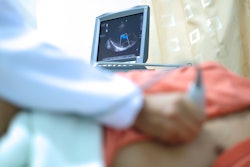
In a response to an AuntMinnie question, Rubins said that astronauts use ultrasound on the International Space Station to diagnose conditions while technicians on Earth guide them.
“[Ultrasound] is the only diagnostic capability we have in space,” Rubins said. “It’s small, it’s handheld, and it’s portable. Ultrasound has really opened up the capabilities for us in terms of what we’re able to see.”
She added that NASA is developing AI tools that can guide ultrasound without dependence on remote technicians guiding the astronauts.
“This is incredibly exciting if you’re thinking about remote medicine elsewhere in the world where you don’t have specialized technicians,” Rubins said. “These things are often tested in space because it is such a frontier.”
Kate Rubins, PhD, discusses medical imaging's current uses in space and how the Trivedi Institute will develop medical tools that can be used in remote areas on Earth.
The new institute’s major donor is Ashok Trivedi, a Pittsburgh-based entrepreneur, investor, and philanthropist, who is donating $25 million through the Trivedi Family Foundation.
The Trivedi Institute will focus on fundamental discovery in space biomedicine, translation into diagnostics, therapeutics, and tools, and resilient systems that can work in low-resource settings.
“We’re going to be able to leverage the incredible knowledge that’s already here and pushing it toward these portable devices,” said Sylvain Costes, PhD, professor of radiation oncology and director of Pitt’s Center for Space Biomanufacturing, Synthetic Biology, and Digital Health.
Costes noted the higher levels of radiation in space that astronauts are exposed to, which the researchers will further study for space travel.
And Christopher Mason, PhD, from Weill Cornell Medicine in New York, told AuntMinnie that imaging will be used for multiple research areas, such as high-resolution molecular imaging.
“This is an infusion of talent and capital that builds a lot of work for new devices, new technologies, and new algorithms that we can use for space,” said Mason, who is also a visiting adjunct professor of surgery at Pitt. “But also, anytime you perfect something in space, that means it works in any remote area on Earth, like say a disaster zone or rural healthcare or military operations.”
Mason was part of a study published in 2024 that described the use of ultrasound imaging, cardiovascular physiology, and cognitive performance, among other health analyses to make way for an in-depth biomedical research approach.
Christopher Mason, PhD, talks about the study he and colleagues conducted that used ultrasound in space and about imaging's role in the Trivedi Institute.
The Trivedi Institute is working with Carnegie Mellon University (also in Pittsburgh), other universities, space agencies, nonprofits, and industry partners to build a global, cross-institutional research and training ecosystem.
This initiative will train scientists, clinicians, and entrepreneurs at the intersection of space biology, biomedicine, and translational health. Pitt said missions and projects are being planned into the 2030s.