CAPE TOWN -- Brain pulsatility in deep gray matter declines significantly with age, according to research findings shared May 13 at the International Society of Magnetic Resonance in Medicine (ISMRM) meeting.
The study is a "first look" into whole-brain pulsatility -- the rhythmic, tiny mechanical movements of brain tissue that occur with each heartbeat -- with healthy aging using 3D amplified MRI (aMRI), presenter Caitlin Neher of the University of Washington in Seattle told session attendees.
 Caitlin Neher at ISMRM 2026 presents her team's results on how amplified MRI (aMRI) reveals how brain pulsatility in deep gray matter declines with age.AuntMinnie.com
"Brain pulsatility reflects cerebrovascular health, and therefore a noninvasive pulsatile imaging method could provide new insights into the vascular health of the aging brain," said Neher, a mechanical engineering researcher.
Aging of brain vasculature is characterized by arterial stiffening, reduced blood flow, and increase pulse wave velocity; these changes are associated with dementia, cerebral small vessel disease, and glymphatic impairment, Neher said.
"Brain pulsatility" is a subtle, repetitive motion that follows the rhythm of the heartbeat. Stiff or damaged arteries transfer pulse energy differently than healthy, elastic ones. This means that measuring pulsatility is an indirect way to assess the brain's cerebrovascular condition.
To investigate any connection between brain pulsatility and aging, Neher and colleagues used aMRI. This technique picks out brain movements that match the rhythm of the heartbeat, strips away unnecessary signal, and produces a whole-brain image that shows how much each region moves at each point in the cardiac cycle.
The study included 31 healthy adults between the ages of 20 and 57, divided into a young adult group (ages 20 to 32, n = 20) and a midlife group (ages 39 to 57, n = 11). All participants underwent 3T, T1-weighted contrast, and cine phase-contrast MRI exams, which were then processed by the aMRI technique.
Across the full cohort, the size or strength of the brain's pulsing movement in deep gray matter decreased significantly with age (p = 0.02), Neher and colleagues found. The researchers also found a preliminary indication of sex- and age-related influence on pulsativity and brain health.
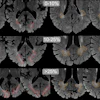
 Representative 3D displacement maps of one subject (female, 24 years old) derived from aMRI. The top row shows the coronal, sagittal, and axial slices of a structural aMRI magnitude image for morphological context, while the bottom row shows displacement fields overlaid; greater pulsatility during the cardiac cycle is seen in areas surrounding the brainstem and cerebrospinal filled regions. Caitlin Neher and ISMRM
The study results suggest potential implications for understanding cerebral small vessel disease, glymphatic dysfunction, and dementia risk, all of which have been linked to altered cerebrovascular pulsatility, Neher said. However, she noted that the current cohort did not extend beyond age 57, and the midlife subgroup skewed toward the early forties, limiting conclusions about older adults.
"Future work should primarily increase older subject recruitment and expand into an older population between 60 and 80 years," she concluded.
Check out AuntMinnie’s ShowCast for full coverage of ISMRM 2026.