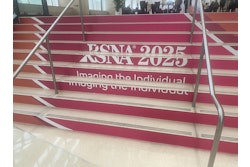
CHICAGO -- AI-based clinical pathways, an MRI scanner suitable for interventional radiology applications, and new interventional imaging platforms were among the highlights for Siemens Healthineers at RSNA 2025.
Siemens directed attention at its booth to four clinical pathways: stroke care, cardiovascular care, cancer care, and Alzheimer’s care. Each pathway depicted how Siemens imaging and therapy technology contributes to care for those clinical applications.
In an effort to target the burgeoning interventional MRI space, Siemens showcased Magnetom Free.XL, a 0.55-tesla scanner designed for use in interventional radiology as well as diagnostic applications.
Developed in collaboration with Cook Medical, the work-in-progress system will utilize the company’s DryCool helium-independent design technology. Free.XL will also feature XL gradients and the firm’s Deep Resolve AI image reconstruction software, enabling cardiac MRI to be performed at 0.55 tesla as part of the clinical routine, Siemens said. Unveiling of Magnetom Free.XL a work-in-progress 0.55T MRI scanner designed for both interventional and diagnostic applications.
What’s more, the scanner will have a complete coil portfolio, including form-adaptive contour and interventional coils. Siemens noted that its Nexaris dockable table can enable patient transfer across diagnostic, intraoperative, and interventional settings.
In addition, the firm’s myNeedle Companion software will provide 3D path planning, skin entry-point marking, and real-time navigation of MR-guided needle-based procedures.
Interventional
In interventional technology developments, Siemens highlighted Optiq AI, an AI-powered imaging chain that’s featured on three new interventional imaging platforms: Artis genio, Artis icono.explore, and high-end Artis icono.vision/Artis pheno.vision systems.
 Artis Explore interventional imaging system.Siemens Healthineers
By reducing noise in real-time during image formation, Optiq AI enables higher-quality low-dose images during image-guided procedures, according to the vendor. This benefits 2D imaging modes, including fluoroscopy, acquisition, and digital subtraction angiography for interventional radiology, cardiology, and minimally invasive surgery, Siemens said. Optiq AI uses big data during image acquisition to automatically find the optimal parameter combination for the user’s imaging needs.
The technology’s parameter exposure control dynamically adjusts tube voltage, tube current, copper prefiltration, focal spot size, pulse width, and detector dose. Parameters are automatically adjusted if the system has to be moved or the angulation or collimation needs to be modified. As a result, the requested image quality can be maintained, and the dose kept as low as reasonably achievable, the company noted.
Optiq AI, Artis icon.explore floor, and Artis genio floor are currently pending U.S. Food and Drug Administration (FDA) 510(k) clearance.
AI
Siemens also highlighted its new AI-powered radiology services suite.
Introduced just prior to the meeting, the new suite will include features that help with scheduling, image acquisition, and reporting, and will incorporate the company's ActExcell Operational Twin, which recommends improvements to operations in hospital departments, it said.
The suite features Remote Reading Services -- consults from radiologists from Siemens' external partner organizations -- and in the future will include a tool called Load Balancing and Scheduling Services, which will match patients and staff with the right scanner at the right time, according to the firm.
Cardiac imaging
Siemens introduced its Syngo.CT Coronary Cockpit software, an application designed to provide AI-powered plaque analysis on cardiac CT exams and facilitate planning of percutaneous coronary intervention (PCI) procedures.
Thanks to AI-based segmentation, labeling, and visualization, Coronary Cockpit can characterize the amount and morphology of coronary plaque, according to the vendor.
 Syngo.CT Coronary Cockpit provides AI-powered cardiac plaque analysis.Siemens Healthineers
Coronary Cockpit can be used with the company’s dual-source and photon-counting CT scanners. It’s currently pending U.S. Food and Drug Administration (FDA) 510(k) clearance.
Women’s imaging
Siemens' Mammomat B.brilliant mammography system has been upgraded with enhanced contrast-enhanced mammography (CEM) and biopsy capabilities.
Wide-angle tomosynthesis can now generate 3D breast images in only five seconds, according to the vendor. What’s more, the scanner will now also be furnished with ClearCEM, an image reconstruction technique designed specifically for contrast-enhanced exams and to support diagnostics in dense breast tissue, Siemens said. The software utilizes algorithms to generate a more uniform background to aid in differentiation of suspicious areas.
If a biopsy is deemed necessary following a contrast-enhanced finding, ClearCEM generates a contrast localizer image for tomosynthesis-guided biopsy that yields targeting accuracy within ±1 mm, the firm said.