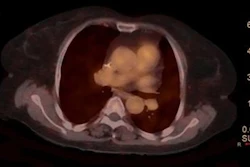
Early FDG-PET imaging may improve outcome estimation in women with newly diagnosed metastatic breast cancer, according to a study published April 16 in JAMA Oncology.
In a trial including 152 patients, those without disease progression on FDG-PET scans two weeks after starting treatment had better median progression-free survival (PFS) and overall survival (OS) than patients with disease progression, noted lead author Jasper van Geel, MD, of the University of Groningen in the Netherlands, and colleagues.
“This broadly available, easy-to-interpret, and patient-friendly assessment may reduce patient and societal burden,” the group wrote.
CT imaging performed every three months is the current standard for assessing treatment response in metastatic breast cancer. That interval can be burdensome for patients and clinicians alike, and CT performs poorly in detecting bone metastases, which account for half of cases, the authors noted.
Alternatively, FDG-PET offers superior sensitivity for bone lesions and can be visually assessed with a straightforward yes/no read, without the size-measurement demands of CT, according to the authors. Yet whether early scans can meaningfully improve outcome predictions over CT has not been prospectively evaluated across all breast cancer subtypes, they wrote.
To that end, the researchers recruited 152 patients with non-rapidly progressive, newly diagnosed metastatic breast cancer at four Dutch academic centers between August 2013 and May 2018. All patients underwent baseline FDG-PET and CT, plus a metastasis biopsy prior to first-line systemic therapy. A second FDG-PET scan was acquired after two weeks of treatment, followed by standard CT response evaluation at eight weeks.
According to the analysis, early FDG-PET demonstrated a negative predictive value of 94.7% for ruling out progression at eight weeks across ER-positive/HER2-negative, HER2-positive, and triple-negative subtypes, as well as in bone-only disease. Patients without progression on early FDG-PET (n = 133) had a median PFS of 19.4 months and OS of 39.4 months, compared with 4.1 months and 18.5 months in those with metabolic progression (n = 19; p < 0.001 for both).
In addition, early FDG-PET refined prognosis within the group that appeared stable on eight-week CT. Patients without CT progression but with metabolic progression on early FDG-PET had a median OS of 19.4 months, versus 40.1 months in those without progression on either modality.
“Early FDG-PET imaging may improve outcome estimation in newly diagnosed metastatic breast cancer compared to standard CT alone,” the researchers wrote.
The authors noted that this was a small study for breast cancer, although among the largest in the field of molecular imaging. In addition, the progression rate on CT at eight weeks was lower than anticipated, reflecting increasingly effective modern treatments, particularly in patients with HER2-positive disease, the group wrote.
“These data support further assessment of early FDG-PET for decision-making in [metastatic breast cancer] treatment,” the researchers concluded.
The full study is available here.