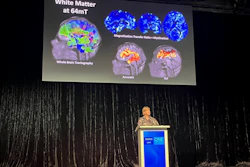
CAPE TOWN - MRI in Kenya is poised for growth, but challenges do remain, according to a talk delivered May 11 at the International Society for Magnetic Resonance in Medicine (ISMRM) meeting.
Presenter Martin Gathogo, MD, of Kenyatta National Hospital in Nairobi, Kenya, painted a picture of the use of the modality overall in Africa as well as specifically in Kenya, highlighting not only the obstacles African radiology faces but also its prospects.
"Africa is a land of opportunity for MRI," he said.
 Martin Gathogo, MD
Gathogo's journey to a career in radiology has been arduous, both in accessing educational resources but also in physically getting to them. In 2010 he began his training at Moyale Subcounty Hospital in Moyale Town, a facility 482 miles from Nairobi, where he lived; at the time there was no internet, television, or radio available, and it took 23 hours to reach the hospital by bus. Police accompaniment was required to protect from bandit attacks.
Fortunately, the road is now fully paved, Gathogo noted.
"The journey is now [only] 13 hours -- and no police escort is needed," he said.
In Kenya, radiologists complete a six-year undergraduate medical degree before advancing to a four-year diagnostic radiology master's degree. There are currently 248 registered radiologists in a country of 53.3 million people, Gathogo said, citing the Kenyan Association of Radiologists (KAR). Radiographers undertake a four-year degree in diagnostic radiology; there is no advanced MRI training or master's degree for this field.
He outlined the history of MRI in Africa, noting that the first system was installed in 1986 in Cape Town, and described the advent of the technology in Kenya in particular: the country's first unit was a 0.2-tesla low-field system installed in Nairobi in 1998. The first 1.5-tesla device was installed in 2005 at Kenyatta National Hospital and in 2019, the hospital installed a 3-tesla system that replaced the 1.5-tesla unit.
Currently, most countries in Africa have access to less than one MRI scanner per million people, he said, and barriers to use of the modality include its high cost, a shortage of trained radiologists, MRI technologists, biomedical engineers, and physicists, and infrastructure limitations such as unreliable electricity. (In comparison, the Organization for Economic Co-operation and Development [OECD] ranks Japan number one globally for MRI density at 57 units per million people, followed by the U.S. at 35 units and South Korea with 34 units.)
"[MRI faces a number of] challenges, including sustainability issues due to poor maintenance and lack of spare parts, the migration of skilled professionals to higher-income countries, economic instability, and competing health priorities, with infectious diseases and primary care taking priority over investment in imaging," he said.
Adding to the challenges of MRI use specifically in Kenya is income disparity, according to Gathogo, who explained that median monthly income in the country is $180 per month compared to more than $6,000 in the U.S. -- and that an MRI costs between $80 and $120.
Yet there is growing "private sector dynamism" regarding MRI, particularly in South Africa, Nigeria, and Kenya, as well as an increase in teleradiology and donor and development financing, he noted. And MRI technology is also improving with the advent of low-field units.
"There's technology leapfrogging potential," he said. "Newer low-field, AI-assisted MRI can reduce cost and infrastructure requirements."
At Kenyatta National Hospital, the daily MRI workload is 15 to 18 patients (400 to 500 per month). There are 15 general radiologists, 10 radiographers, and six nurses. Gathogo reads MRI exams twice a week, and also interprets CT, ultrasound, and x-ray studies. The hospital uses Medweb PACS and Philips Advanced Visualization Workspace for analysis of spectroscopy and dynamic contrast exams. No perfusion or diffusion tensor imaging (DTI) sequences are performed, and the department does not have access to AI tools for image acquisition, reconstruction, or reporting.
"Kenya's MRI infrastructure remains critically under-resourced relative to global standard," Gathogo said.
To conclude his talk, he outlined ISMRM's partnership opportunities, urging the society to "establish an MRI equipment pipeline with end-to-end installation support" and to "build local maintenance capacity and spare-part networks ensuring donated equipment delivers lasting value." The ISMRM can also help boost African representation on global MRI research by cosponsoring "annual symposia and collaborative research projects that generate publishable outcomes" and funding fellowships for African radiologists, technologists, and physicists so that they can bring expertise home to train others.
Check out AuntMinnie's full coverage of ISMRM 2026 on our ShowCast.