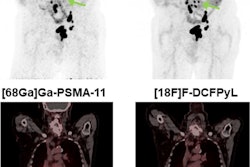
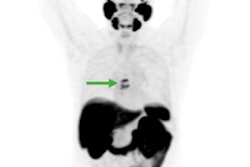
F-18 PSMA-1007 detects higher rates of prostate cancer recurrence than Ga-68 PSMA-11 in patients with low levels of prostate-specific antigen (PSA), according to a study presented May 12 at the ISMRM meeting.
The finding is from a comparison of the two PET radiotracers among 220 patients who had undergone radical treatment and whose median PSA at the time of imaging was 0.35 ng/mL, noted presenter Tone Bathen, of the Norwegian University of Science and Technology in Trondheim.
"F-18 PSMA-1007 should be considered the tracer of choice for patients who are candidates for salvage radiotherapy, in particular at PSA levels below 0.5 ng/mL," Bathen noted.
Biochemical recurrence following radical prostatectomy for prostate cancer is commonly managed with salvage radiotherapy, which current guidelines recommend initiating before PSA levels rise above 0.5 ng/mL, according to Bathen and colleagues. While prostate-specific membrane antigen (PSMA) PET imaging has emerged as the most sensitive modality for detecting prostate cancer, its performance decreases at low PSA levels and varies depending on which PSMA tracer is used, they added.
To offer evidence on which tracer may be best, the group recruited 220 patients at three university hospitals in Norway between May 2020 and April 2023. Participants presented with biochemical recurrence, defined as a confirmed PSA level ≥0.2 ng/mL following prostatectomy. Subjects had a median age of 69 years and the median time since primary treatment was 37 months. Median PSA at imaging was 0.35 ng/mL.
The imaging protocol included PET/MRI from neck to proximal thighs, PET/CT from vertex to proximal thighs, and multiparametric MRI of the pelvis. Tracer availability at each hospital determined which PSMA tracer was used. Imaging was performed with F-18 PSMA-1007 in 66% of cases and Ga-68 PSMA-11 in 34%.
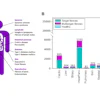
 Patient level detection rates for patients (N = 220) with biochemical recurrence after radical prostatectomy.Tone Bathen, PhD, and ISMRM
“The significantly higher detection rates observed with F-18 PSMA-1007 at low PSA levels support its use as the preferred tracer when available,” Bathen and colleagues wrote.
The researchers highlighted the strengths of the hybrid PET/MRI approach, which enables the integration of anatomical and functional MRI data to clarify ambiguous PET findings. When PET reveals uncertain lesions, multiparametric MRI (mpMRI) can contribute critical information to either confirm or dismiss the presence of true pathology, improving lesion characterization, they noted.
“Future analyses will include direct comparison with mpMRI and regional lesion mapping to refine diagnostic accuracy and guide personalized salvage treatment strategies,” the group concluded.
Check out AuntMinnie’s ShowCast for full coverage of ISMRM 2026.