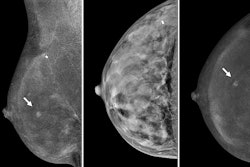
CHICAGO -- Adding digital breast tomosynthesis (DBT) to contrast-enhanced mammography (CEM) leads to slight decreases in false-positive recalls, according to research presented December 2 at RSNA 2025.
Wendie Berg, PhD, from the University of Pittsburgh School of Medicine in Pennsylvania, presented results from her team’s study, showing that this approach led to a 5% decrease in false-positive recall rates while maintaining high sensitivity.
“It can be done in the exact same positioning at the same time as a CEM exam,” Berg told AuntMinnie. “Some of these patients have had a tomosynthesis prior to enrolling in the study, and some had it at the same time as a contrast mammogram.”
DBT reduces false-positive recall rates and slightly improves breast cancer detection. While prior research suggests that 2D mammography can benefit from the addition of DBT, Berg and colleagues wanted to find out how adding DBT to CEM affects reader performance.
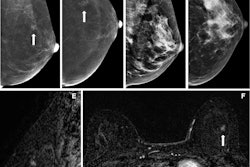
Five breast radiologists with 0.2 to five years of experience interpreting CEM images retrospectively reviewed 403 screening CEM exams enriched in malignancies. The radiologists first reviewed low-energy images, recorded any recalled findings electronically, and locked in forced BI-RADS assessments.
Then, they reviewed contrast-enhanced recombined images, with the researchers asking the radiologists if and how these images led to changes in BI-RADS assessments of each low-energy finding. The radiologists recorded any newly seen recalled findings and assessments.
Finally, the researchers showed the radiologists DBT images and asked them if DBT altered the assessment of any low-energy or recombined findings.
Among the 335 interpretations of the 67 malignant cases included in the study, 120 were recalled on low-energy imaging alone. Adding the recombined images led to a total of 250 images being recalled (odds ratio [OR] = 5.4).
However, adding DBT to low-energy plus recombined images led to no significant changes (OR = 0.98).
Wendie Berg, PhD, discusses the implications of her team's research on adding DBT to CEM exams.
Across the five radiologists, low-energy images alone led to a 24.4% false-positive recall rate. But adding recombined images increased this to 39.6% (p < 0.001). However, Berg said this increase was outweighed by the increase in sensitivity, leading to an increase in area under the curve (AUC) from 0.57 to 0.75 (p < 0.001).
Adding DBT to low-energy plus recombined images decreased the false-positive recall rate to 34.7% (overall OR = 0.80, p < 0.001). However, this did not significantly change the AUC (0.76 vs. 0.75, respectively).
Of the 204 recalled lesions, the addition of DBT led to 28 lesions that were recalled on recombined images being downgraded to BI-RADS 2. Four of these downgraded lesions turned out to be malignant. Adding DBT also led to five additional upgrades, all being invasive ductal carcinomas.
Berg said the additional radiation exposure from adding DBT to CEM needs to be considered. However, she added that this remains within accepted limits.
Berg told AuntMinnie that the team will next focus on quantifying variability and training, which she said will be important for widespread implementation.
“I’ve given feedback to the manufacturers about things like the thicker areas of scarring that need to be processed better so that we don’t misinterpret those,” she said.
For full coverage of RSNA 2025, visit our RADCast.