CHICAGO -- An AI-based decision support tool could reduce unnecessary biopsies of benign breast lesions by about 60%, according to research presented December 4 at RSNA 2025.
In his talk, Michael Fishman, MD, from Mass General Brigham in Boston, MA, shared results from his team’s findings showing that the AI tool for breast ultrasound maintained high sensitivity for detecting malignancies while identifying benign lesions.
Reports suggest that between 60% and 80% of breast biopsies performed in the U.S. result in benign pathology, adding unnecessary cost and burden to patients. Fishman said this highlights a need for improved diagnostic specificity.
He and colleagues evaluated the potential impact of an AI tool (Koios DS, Koios Medical) cleared by the U.S. Food and Drug Administration (FDA) for breast ultrasound. The researchers conducted their prospective study in 2025 at two academic medical centers.
Fourteen breast imaging radiologists participated by documenting cases categorized as BI-RADS 4 with a recommendation for ultrasound-guided biopsy, along with the corresponding AI output. All women included underwent ultrasound-guided core biopsy, ultrasound-guided aspiration, or surgical excision. Final histopathology served as the reference standard.
The study included 107 ultrasound-guided biopsies performed on 102 women with an average age of 55.4 years. The women’s ages ranged from 27 to 92 years. Of the total biopsies, 23.4% (n = 25) yielded malignant pathology, while 76.6% (n = 82) were benign.
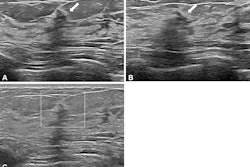
The AI algorithm classified 96% (n = 24) of malignant lesions as BI-RADS 4 and 4% and the remaining one as BI-RADS 3. The lone BI-RADS 3 lesion found by the AI tool was a 6-mm grade 1 invasive ductal carcinoma in a 77-year-old woman.
Among the benign cases, the AI tool assigned 46.3% (n = 38) as BI-RADS 2, 22% (n = 18) as BI-RADS 3, and 31.7% (n = 26) as BI-RADS 4.
The team retrospectively applied the AI output to biopsy triage decisions and found that 68.3% of benign biopsies could have been avoided, with one malignant case potentially missed.
Fishman said these results favor AI’s integration to improve the specificity of breast ultrasound interpretation in clinical practice.
“Integrating AI into breast ultrasound workflows may substantially decrease benign biopsy rates and enhance clinical decision-making,” he added.
Visit our RADCast for full coverage of RSNA 2025.