Researchers in Denmark have laid the groundwork for testing a new theranostic pair in patients with neuroendocrine lung tumors, according to a study published January 8 in the Journal of Nuclear Medicine.
In a prospective phase II trial in 19 patients with either small cell lung cancer (SCLC) or large cell neuroendocrine lung cancer (LCNEC), the group visualized tumors using a PET radiotracer named gallium-68 (Ga-68) SSO120, noted lead author Tine Christensen, MD, of Copenhagen University Hospital, and colleagues.
“Ga-68 SSO120 PET/CT successfully visualized SCLC and LCNEC lesions during and after chemotherapy. Therapeutic studies with [lutetium-177 SSO110], the theranostic companion of Ga-68 SSO120 PET, are warranted,” the group wrote.
SCLC and LCNEC are aggressive and characterized as neuroendocrine lung cancers. Treatment options are limited, and the prognosis is poor in both types. Like other neuroendocrine cancers, SCLCs and LCNECs overexpress somatostatin receptor 2 (SSTR2), a receptor on tumor cell surfaces.
Ga-68 SSO120 and its companion lutetium-177 (Lu-177) SSO110 are being developed by Berlin-based Ariceum Therapeutics, with several groups evaluating their safety and efficacy. In one previous study, researchers found that Ga-68 SSO120 PET/CT was comparable to standard F-18 FDG PET/CT for the initial staging of SCLC. In this study, Christensen and colleagues further investigated the uptake of Ga-68 SSO120 in patients as a step toward determining optimal timing for treatment with Lu-177 SSO110.
The group recruited 19 patients with biopsy-confirmed SCLC or LCNEC who were undergoing palliative chemotherapy (n = 11) or surveillance (n = 8) at two university hospitals between September 2023 and April 2024. Approximately 60 minutes after being injected with the imaging agent, all patients underwent whole-body PET/CT scans (Biograph Vision 600 Edge or Biograph Vision 600, Siemens Healthineers). All participants also had a diagnostic contrast-enhanced CT.
Two board-certified nuclear medicine physicians with more than 10 years of experience each analyzed the PET/CT imaging, while the CT scans were evaluated by a board-certified radiologist. The primary endpoint was the fraction of patients with at least one lesion detectable by Ga-68 SSO120 PET/CT, while secondary endpoints included comparisons of the number of lesions and sites identified by Ga-68 SSO120 PET/CT versus CT.
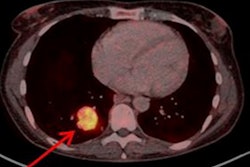
 Examples of Ga-68 SSO120 PET/CT. Transversal CT (upper left), Ga-68 SSO120 PET (upper right), fused Ga-68 SSO120 PET/CT (lower left), and maximum-intensity-projection (lower right) images are shown. (A) High Ga-68 SSO120 uptake in primary SCLC tumor (red arrow; SUVmax, 26.4) and mediastinal lymph nodes (blue arrows; SUVmax, 19.4) three months after end of four cycles of carboplatin plus etoposide. (B) High Ga-68 SSO120 uptake in primary LCNEC tumor (red arrow; SUVmax, 8.1) and metastatic pleura (blue arrow; SUVmax, 8.3) after third cycle of etoposide as monotherapy. (A and B) Physiologic uptake in pituitary gland, salivary glands, spleen, liver, adrenal glands, kidneys, and bladder is shown.Journal of Nuclear Medicine
“In this prospective clinical trial, Ga-68 SSO120 PET/CT successfully visualized SCLC and LCNEC lesions during and after chemotherapy, detecting malignant tumors in 18 of 19 patients,” the group wrote.
The findings support further therapeutic studies of Lu-177 SSO110 radiopharmaceutical therapy in patients with SCLC and LCNEC, either after first-line chemotherapy or at later stages, such as at the time of relapse, the group concluded.
The full study is available here.