CHICAGO -- At RSNA 2025, GE HealthCare (GEHC) is showing off a variety of new offerings, including two new MRI scanners, a photon-counting CT (PCCT) scanner, and 3D mammography image reconstruction software.
MRI
GEHC unveiled two MRI systems for which it has applied for U.S. Food and Drug Administration (FDA) clearance: Signa Bolt, a high-field, wide-bore 3-tesla system that features GEHC's Signa One MRI workflow algorithm, and Signa Sprint with Freelium, a ventless 1.5-tesla system that uses less than 1% of helium required for conventional MRI, according to the firm, and which can be used with the company's deep-learning offerings, AIR Recon DL and Sonic DL.
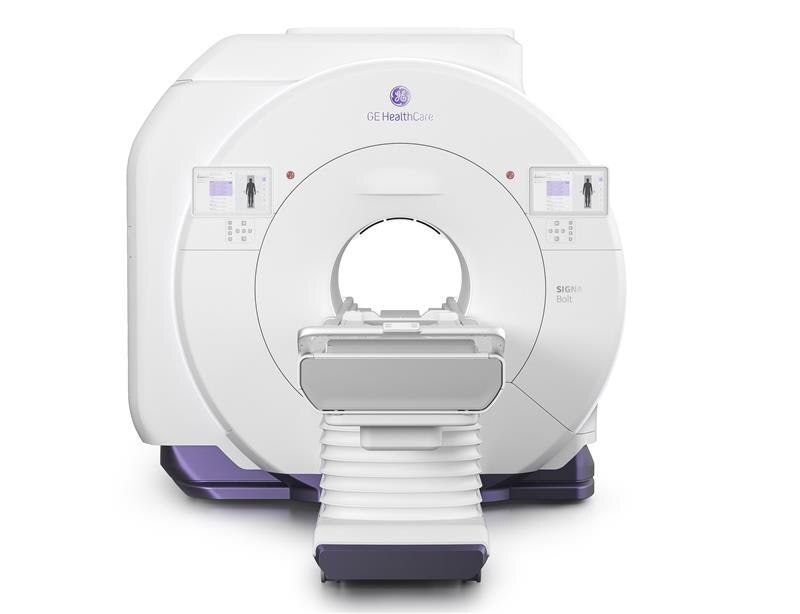 GE HealthCare's Signa Bolt wide-bore, 3T MRI scanner.GE HealthCare
Both systems utilize Signa One, an AI-driven workflow platform. Signa One features an intuitive user experience designed to reduce training time and boost productivity, according to the vendor. It also includes a specialized table and contactless respiratory and peripheral gating, as well as the company's Signa One Camera with In-Room Console live feed.
CT
The company has submitted a 510(k) application for a new photon-counting CT (PCCT) system called Photonova Spectra, which boasts 8-bins of energy resolution and is built on GEHC's Deep Silicon semiconductor detector technology. It has also filed for clearance for True Definition DL, an algorithm intended to support fast scan times and long scan ranges for pulmonary, musculoskeletal, and inner ear imaging and for use with its Revolution Apex and Revolution Vibe platforms.
Also on the CT front, the company is touting an upgrade to its advanced visualization platform, AW One, which now includes VersaViewer with One View for simplifying spectral CT interpretation; CardIQ Suite v2, cardiac CT postprocessing software that assists with calcium scoring and coronary CT angiography interpretation; and SnapShot Freeze v3, which reduces motion artifacts on heart imaging.
Digital X-ray
X-ray systems being highlighted in GEHC's booth included the floor-mounted Definium Pace Select ET, which features automation tools that reduce workflow steps and another that reduces image variability, and a new overhead tube suspension system, Definium Tempo Select. The company also exhibited its new Helix Advanced Image Processing 3.0 software that streamlines image review.
Enterprise Imaging/AI
GEHC has launched Genesis Radiology Workspace, a workflow platform that includes 510(k)-pending Genesis View, a new viewer integrated into all the firm's Genesis cloud offerings that allows radiologists to reject or modify AI findings provided by AI apps. Genesis Radiology Workspace features user-defined AI prioritization -- to bring critical findings to the top of the workflow, for example.
The company is also highlighting upgrades to its workflow platform, Imaging 360 with AI, which features new machine-learning tools, clustering algorithms, statistical models, and decision-tree frameworks that help users "automate actionable insights," manage protocols across an entire imaging fleet, and connect staff remotely.
Molecular Imaging
As for molecular imaging, the company is touting receipt of the European CE Mark for its next-generation Omni total body PET/CT system and for StarGuide GX, a digital 4D SPECT/CT system.
Omni has a 128-cm axial field of view to accommodate head-to-thigh imaging in a single bed position. It supports ultralow dose scans, multiorgan dynamic imaging, and imaging of low-activity tracers. StarGuide GX images at all energy levels for general-purpose SPECT exams and can be used to explore investigational therapies such as actinium-225, according to the firm.
GEHC also displayed its MIM LesionID Pro software, which provides automated total tumor burden data such as total tumor volume, mean standardized uptake value (SUV), and maximum SUV on prostate-specific membrane antigen (PSMA) PET/CT and SPECT/CT scans, and MIM Encore, a workflow platform for PET and SPECT imaging exam reporting.
Women's Imaging
In its booth, GEHC showcased its 3D mammography image reconstruction software Pristina Recon DL, for which it secured premarket approval from the FDA in November, and displayed its existing mammography systems Pristina Via and SenoBright HD Contrast Enhanced Mammography (CEM).
Advanced Visualization and Ultrasound
On the interventional side, the company is displaying its bkActiv S series, which it launched in June and which is part of its bkPortfolio of Active Imaging systems for guidance during interventional urology, colorectal, and pelvic floor procedures. It is also showcasing its OEC 3D interoperative mobile conebeam CT technology.
For ultrasound, GEHC is showcasing its Invenia Automated Breast Ultrasound (ABUS) Premium system, which it launched in March, as well as its Logiq family of ultrasound systems, which include Logiq E10, Logiq Fortis, and Logiq Totus. The firm now offers to U.S. customers a subscription arrangement called Logiq E10s Subscription Package, which provides users with software updates and upgrades for five years.
In addition, GEHC is directing attention to its point-of-care ultrasound (POCUS) systems, Venue Sprint, Venue Fit, Venue, and Venue Go, and is introducing a new tool called Nerveblox, which automatically labels anatomical landmarks in ultrasound images during peripheral nerve block procedures.
For full RSNA 2025 coverage, click here.