CHICAGO -- Ultrasound-guided cryoablation is effective in treating early-stage invasive breast cancer in older women who do not undergo axillary surgery, suggest findings presented December 3 at RSNA 2025.
In his presentation, Jorge Rey Porras, MD, from La Paz University Hospital in Madrid, Spain, shared his team’s findings showing how cryoablation can treat estrogen receptor (ER) positive and negative cancers at clinical stages I and II.
“Cryoablation is a safe, minimally invasive, and highly effective alternative for elderly women with ER+ cancer,” Porras said.
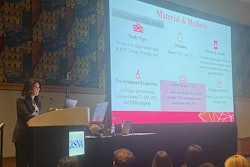
 Jorge Rey Porras, MD, discusses results from his team's study on cryoablation for treating early-stage breast tumors in older women. Next to him include session moderators Sarah Vinnicombe (left) and Steven Poplack, MD (middle).
While most breast cancers in older women are ER+ and have more favorable biology, comorbidities in this patient population may prevent older women from undergoing surgical treatment. And while sentinel lymph node biopsy is traditionally used as part of the treatment, recent studies suggest that omitting this step in ER+ cases does not increase disease recurrence. This could help women avoid complications from surgery, Porras said.
Researchers continue to explore the use of cryoablation to treat small tumors with minimal invasiveness. Prior research highlights the technique’s effectiveness, safety, and tolerance for patients.
Porras and colleagues retrospectively reviewed local recurrence and local control rates in 77 women with a total of 82 early-stage invasive breast tumors treated with cryoablation and omission of axillary surgery. This included a minimum follow-up of 18 months. The women had an age range of 58 to 96 years with an average age of 83.
The researchers categorized the women as ER+ (n = 69 tumors) or ER- (n = 13 tumors), with the ER+ women also receiving adjuvant hormonal therapy. Follow-up included semiannual ultrasound and annual mammography.
Ultrasound-guided cryoablation led to 100% overall local control in ER+ cases and 84.6% for ER- cases. The ER+ group experienced a greater average time to recurrence (21 months) and average follow-up duration (31 months) compared with the ER- group (10 months’ time to recurrence, 20 months follow-up).
The team also reported two repeat cryoablations performed in the ER+ group compared to five in the ER- group.
Finally, the researchers reported no major complications in either group.
Porras said the results favor cryoablation as a viable alternative for elderly women with early-stage, ER+ breast cancer. This can make way for omitting axillary surgery without negatively affecting local control, though women with ER- cancers will need more careful selection, he added.
“In the future, it would be interesting to see the role of cryoablation in younger patients with combined therapies,” Porras said.
The research earned a Trainee Research Prize from the RSNA. To see full coverage of RSNA 2025, visit our RADCast.