Fibroblast activation protein inhibitor (FAPI)-46 PET/CT outperforms FDG-PET/CT in detecting and characterizing unclear hepatic lesions, according to a study published April 16 in the Journal of Nuclear Medicine.
In a prospective head-to-head comparison among 59 patients, researchers at the Medical University of Graz in Austria found that gallium-68 (Ga-68) FAPI-46 PET/CT achieved 100% sensitivity for intrahepatic malignancy compared with 70% for FDG-PET/CT.
“The potential of Ga-68 FAPI-46 PET/CT for detecting primary intrahepatic tumors and liver metastases of extrahepatic malignancies is superior to that of F-18 FDG-PET/CT,” wrote first author Susanne Stanzel, MD, and colleagues.
Given its aggressive nature, early and accurate diagnosis of hepatocellular carcinoma (HCC) is essential for optimizing therapeutic strategies, the authors explained. While FDG-PET/CT is widely used for oncologic staging, its sensitivity in HCC is limited due to low FDG uptake in well-differentiated tumors. Conversely, FAPI tracers, which target fibroblast activation protein expressed in tumor stroma, have emerged as a promising alternative for hepatic lesion characterization, yet prospective head-to-head data compared to FDG-PET are limited, the authors noted.
To further explore FAPI-PET's value, the researchers recruited 59 patients with suspicious intrahepatic lesions based on contrast-enhanced CT or MRI scans between July 2022 and December 2024. All patients underwent both Ga-68 FAPI-46 PET/CT and FDG-PET/CT (Discovery MI, GE HealthCare) within a two-week window. The Ga-68 FAPI-46 scan included abdominal dynamic imaging in addition to a static scan, which allowed the group to differentiate malignant from benign lesions based on uptake patterns.
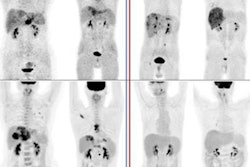
 A 65-y-old man with HCC and liver cirrhosis confirmed by MRI. Ga-68 FAPI-46 PET/CT demonstrates increased focal uptake (SUVmax, 13.26, and TBRmax, 2.89) in liver, whereas F-18 FDG-PET/CT scans showed non–F-18 FDG-avid lesion (SUVmax, 3.24, and TBRmax, 1.43), indicated by solid arrows. Additionally, histologically proven adenocarcinoma in colon transversum was identified as pathologic with Ga-68 FAPI-46 alone (dashed arrows). Journal of Nuclear Medicine
“These findings suggest that Ga-68 FAPI-PET/CT enhances the diagnostic accuracy of unclear hepatic nodules, potentially leading to improved patient management and treatment outcomes,” the group wrote.
The authors noted limitations, namely that not all positive findings were confirmed by biopsy, and only a small number of HCC tumors had available differentiation grading; thus, validation of the results is warranted in larger biopsy-proven cohorts.
"Ga-68 FAPI-46 PET/CT has a substantial impact on treatment management by enabling early, accurate diagnosis in [primary hepatobiliary tumors] and [intrahepatic metastases] and by avoiding unnecessary invasive exploration of benign hepatic tumors," the researchers concluded.
The full study is available here.