Real-world insights support the benefits of implementing cardiac PET imaging with F-18 flurpiridaz in patients with suspected heart disease, a group in the Netherlands has reported.
The findings are from an analysis of patients referred for rest-stress myocardial perfusion imaging (MPI) between December 2022 and September 2024 from an institution that previously performed SPECT MPI only, noted Marjolein Hol, MD, of the University Medical Center Utrecht, and colleagues.
“This first real-world cohort of 150 patients demonstrates the clinical feasibility and diagnostic utility of F-18 flurpiridaz PET for routine myocardial perfusion imaging in a clinical setting,” the group wrote. The study was published January 21 in the Journal of Nuclear Cardiology.
MPI PET is used for diagnosing coronary artery disease based on its accuracy and ability to quantify myocardial blood flow (MBF). The widespread use of the technique over standard SPECT imaging has been limited until recently by the short half-lives of most common PET radiotracers, such as oxygen-15 water (two minutes) and nitrogen-13 ammonia (10 minutes), the authors noted.
With a half-life of 109 minutes, F-18 flurpiridaz is a new cardiac PET tracer that overcomes these limitations. The tracer was recently approved by the U.S. Food and Drug Administration (FDA) based on two phase III trials. In this study, the researchers aimed to provide real-world insights into its clinical implementation.
Out of the 150 patients (mean age, 65.3; 60% male) who underwent imaging (Biograph mCT, Siemens Healthineers), 67 had no history of coronary artery disease (CAD), 73 patients had a previous history of CAD, and 10 patients had a history of heart transplantation. Two nuclear medicine physicians with four and 15 years of experience interpreted the scans.
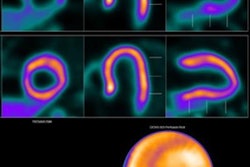
 Ischemia in the circumflex territory. F-18 flurpiridaz PET showed a perfusion defect in the lateral wall during pharmacological stress, which improved in rest. Myocardial blood flow (MBF) quantification showed decreased MBFstress (1.4 mL/min/g) and myocardial flow reserve (MFR) (2.2) in the circumflex (Cx) territory, with adequate flow in the left anterior descending and right coronary artery territories, MBFstress 2.6 and 2.2 mL/min/g, and MFR 3.4 and 3.1, respectively. Coronary angiography showed a 70%-99% stenosis in the Cx artery, for which percutaneous coronary intervention was performed with good result and good clinical outcome.Journal of Nuclear Cardiology
In the 10 patients who showed no obstructive CAD, five were deemed to have microvascular dysfunction, and five were deemed false positives due to motion artifacts, the researchers reported.
“This report provides real-world insights into the clinical implementation of F-18 flurpiridaz PET in a diverse patient population,” the group wrote.
Ultimately, while F-18 flurpiridaz PET MPI demonstrates high image quality and diagnostic confidence, early adopters of the technique transitioning from SPECT MPI should be aware of practical challenges, according to the researchers. Specifically, the high spatial resolution of F-18 flurpiridaz PET increases its susceptibility to motion-related artifacts, they noted.
“These findings highlight the growing importance of incorporating motion correction techniques into standard workflows,” the group wrote.
The full study is available here.