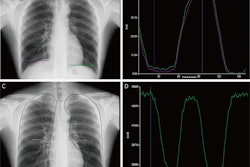
CHICAGO -- Dynamic chest radiography (DCR) significantly improves the detection of lung cancer lesions over conventional chest x-ray, according to research presented December 1 at the RSNA meeting.
In a study led by Koji Takumi, MD, PhD, of Kagoshima University in Kagoshima, Japan, that compared the two modalities, DCR was particularly useful in cases complicated by anatomical overlap.
“This enhanced performance highlights [DCR’s] potential as a valuable tool for early and accurate diagnosis of surgically treatable lung cancer,” Takumi told attendees.
 Koji Takumi, MD, PhD, presents research on dynamic chest radiography at RSNA on December 1.
In this study, to further assess its potential value, Takumi and colleagues compared its diagnostic performance compared to conventional chest x-ray for detecting lesions in 100 patients who underwent imaging with both modalities prior to surgery. Three chest radiologists reviewed all images, with any discrepancies among them resolved by consensus.
The readers rated their diagnostic confidence in the two approaches using a 3-point scale (2: definite presence, 1: probable presence, 0: difficult to identify), with a score of 1 or higher defined as a detectable lesion. The readers compared lesion size, location, morphology, histological subtype, and the presence of overlapping structure between detectable and undetectable lesions for both techniques.
The researchers also evaluated the performance of an AI model approved in Japan for detecting abnormalities on conventional chest x-rays.
According to the results, DCR received higher confidence scores, as well as higher detectability scores: detectability with DCR was 81% (81/100 lesions), while conventional x-ray received a score of 71% (71/100) (p = 0.002). The AI-based software received a detectability score of 64% (p < 0.001).
“In both [conventional chest x-ray] and DCR, lesions with a larger size, a solid morphology, and no overlap with normal structures were more likely to be identified,” Takumi said.
Further, of 29 lesions that were difficult for radiologists to identify on conventional chest x-ray, 10 were successfully detected using DCR, all of which overlapped with normal anatomical structures on conventional chest x-ray. For almost all lesions (98.6%) that were initially diagnosed with a confidence level of 1 on conventional x-ray by radiologists, the confidence level improved on DCR.
Takumi noted that previous studies have reported a false negative rate of up to 32% in conventional chest x-ray for detecting pulmonary nodules and that lesions located in obscured areas of the lung, overlapped by the mediastinum, hilum, pulmonary apex, or diaphragm, are challenging and have been reported undetectable in approximately 87% of cases.
“DCR enhances the detectability and diagnostic confidence of lung cancer lesions, particularly in cases where CCR is limited by anatomical overlap, serving as a valuable complement to both conventional interpretation and AI-assisted analysis in clinical practice,” he concluded.
For full coverage of RSNA 2025, visit our RADCast.